
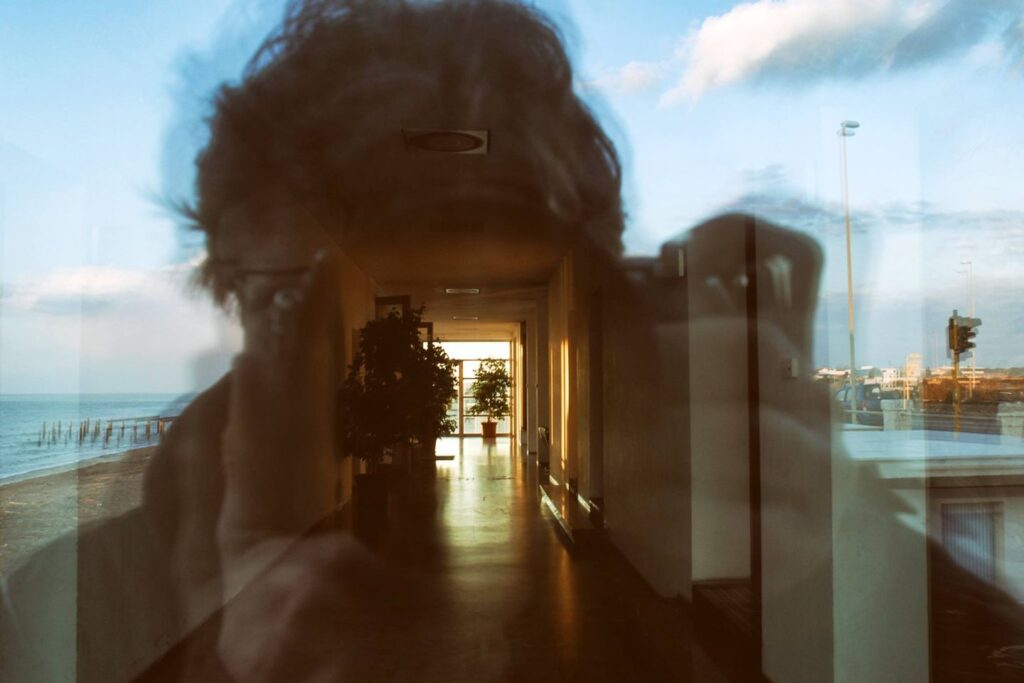
If one believes, like the philosopher, that it is good not to multiply entities praeter necessitatem, one will probably think that the photographic self-portrait is not a field where too many distinctions need to be drawn. And yet, within what is perhaps the most widely practiced genre of recent years, a profound difference exists: on one side, the images that were once obtained with a tripod and self-timer and that today are produced above all with the front camera of a mobile phone pointed at oneself; on the other, those that make use of a reflection in a mirror or a pane of glass.
The difference is that, while in the first case the author chooses to represent himself as a subject being photographed — a spectrum, to use Roland Barthes’s term — in the second it is his role as operator that becomes the material of the image. Not only because the camera appears within the frame1, but also and above all because, when the silhouette alters the reflection, rendering it opaque and revealing objects and details that would otherwise be invisible, it is the photographer’s role as the one who “generates” the image that enters among the elements captured by the shot.
And yet the expressive potential of the “self-portrait in reflection” can go further still, as Mauro Quirini shows us in this image, which condenses the essential core of his poetics: first, the coastal landscape that surrounds him and that — as anyone familiar with his body of work will know — appears in the majority of his shots, the fruit of tireless and attentive explorations of the Ostia seafront in search of the poetry that the Tyrrhenian Sea whispers in its endless breathing; and then the absence of the human figure, another recurring motif in his photography, which stands out at the center of the image — the one that appeared precisely thanks to his silhouette — where a dimly lit corridor opens onto the landscape through a window pane that recalls a lens mounted on a gigantic objective. And in the corridor, two plants evoke the objects Quirini admits into his frames, almost like metaphysical characters, silent traces of a humanity just departed or long awaited.
In short, a self-portrait that reveals everything about its author except his face; but for that, a passport photo booth will do. To unveil one’s own idea of photography, something more is required: a capacity for storytelling that grows from a precise and deeply felt way of seeing the world. Perhaps the true subject of a self-portrait in a mirror, when it succeeds, is neither the mirror nor the camera nor the person using it — it is a way of looking.
The photographs and images on this page, in compliance with copyright law, are reproduced for purposes of criticism and discussion pursuant to Articles 65, paragraph 2; 70, paragraph 1-bis; and 101, paragraph 1 of Law 633/1941.
English translation based on Claude.ai translation services.
- It sometimes happens that the photographer manages to compose the image in such a way as to exclude the reflection of the camera — as for example in the photograph by Stefano Mirabella described in this article.[↩]
[Commento al post su Facebook di Pasquale Liguori]
Vorrei aggiungere un’ulteriore dimensione a questa lettura: oltre all’uomo, al paesaggio marino e all’ambiente costruito della quotidianità, questa fotografia credo compia qualcosa di ancora più sottile e paradossale. Il mezzo che tecnicamente la produce viene inghiottito dalla composizione che essa stessa genera. È inevitabilmente presente, è la condizione di possibilità dell’intera immagine, eppure non si rappresenta: si dissolve nel corpo, nell’ombra, nei piani sovrapposti della riflessione sul vetro.
Il gesto del fotografare è invece leggibilissimo. L’azione sopravvive allo strumento che la rende possibile.
È quasi un gesto che induce autoannullamento da parte del mezzo che diviene invisibile nel momento in cui è massimamente operante. Un McLuhan rovesciato, non il medium è il messaggio, ma il medium sparisce dentro il messaggio che genera.
[Commento di Carlo Viola al post su Facebook]
Una fotografia che ha molteplici piani di lettura. Sembra una azzeccato esempio della “soglia” di cui parlava Ghirri (e la poetica di Quirini, consapevolmente o meno, sembra essere esattamente la stessa di Luigi Ghirri).
Vero. Qui la soglia che viene messa in gioco è quella che è sottesa da ogni fotografia. La soglia tra chi vede e chi è visto, che il riflesso ribalta e rende visibile. I riferimenti a Ghirri credo appiano spesso negli scatti di Quirini, ad esempio quelli del litorale romano. Anche se egli spesso declina in atmosfere aurorali e crepuscolari le spiagge deserte che Ghirri immerge nel sole e nei colori tenui del pieno giorno.