
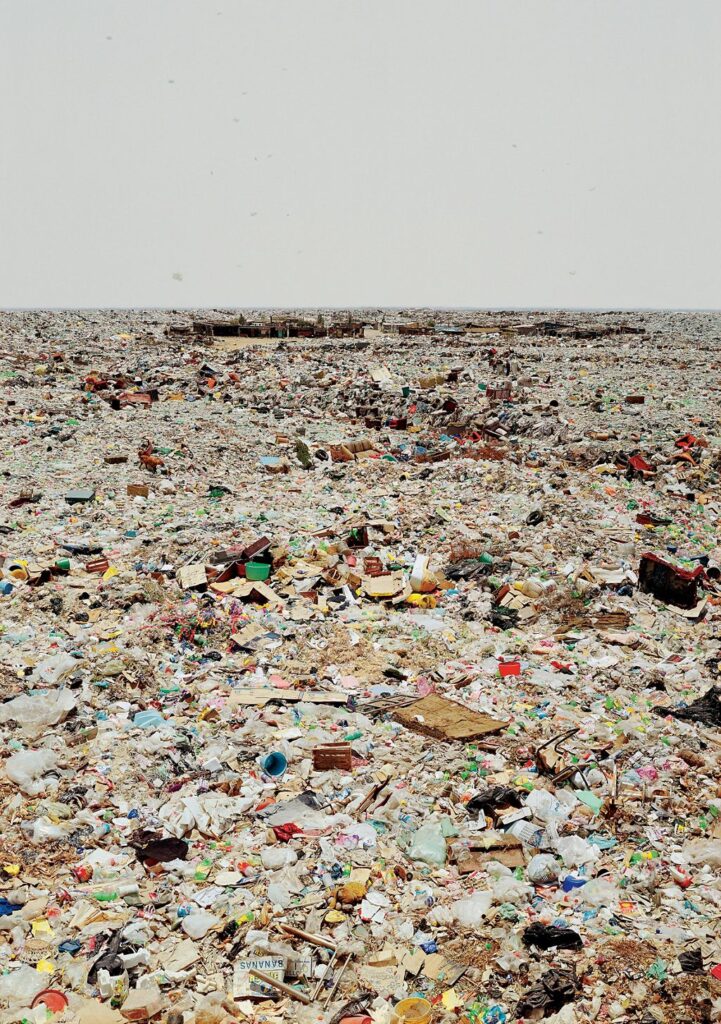
There is a word for that mixture of wonder, anguish, and fascination that overtakes us when our experience of the world is pushed to the very limits of its capacity to organize and make sense of things, and that word is sublime. On that feeling of “delightful horror” — as Edmund Burke called it — pages that were considered definitive in their time can be found in Immanuel Kant’s Critique of the Power of Judgment; both types of the sublime he identified — the mathematical and the dynamical — were connected to natural phenomena. Evidently, up to that point, human beings had not managed to generate anything comparable to a volcanic eruption or the immense vastness of the starry sky.
But in the two and a third centuries that have passed since Kant’s taxonomy, our civilization has succeeded in creating its own kind of sublime — stable, replicable — which might be called the artificial sublime. This is no small novelty, first and foremost because of the impact this new sublime has on the planet’s capacity to go on producing its own, but also because of the consequences it carries for the plane of representation itself.
For Kant’s contemporary, the necessary — perhaps the only — instrument for giving sensible form to the sublime was ellipsis: Leopardi’s hedge, Caspar David Friedrich’s sfumato, both evoked an “indefinite infinite” within the finite space of a poem or a painting. For the sublime that bears our own trademark, it is clear that one must operate on a different register. Because everything that lies across the immense expanse of the Chimalhuacán landfill in Mexico City — every piece of plastic, every tin can, every carcass of a television set or a computer, even the dog sniffing and tearing at the shopping bags — was brought there by human hands. And so its representation must offer the human eye the mirror-image possibility — or illusion — of being able to enumerate every single element: a kind of hypervision capable of displaying mastery over this overflowing artificiality and warding off the sensation of being on the verge of losing control over what we ourselves have created and are unable to contain.
For this reason, the images of Andreas Gursky earn, by tortuous paths, an adjective that photography history textbooks usually deny to members of the Düsseldorf School: poetic. A poetry that works through inexhaustible accumulation, in a spreading “vertigo of the list” that denies our sublime one property that Kant considered structural to this feeling: physical detachment. Unlike the perfect storm to be admired safely from a clifftop, the refuse of Chimalhuacán reaches all the way to the observer’s position and — perhaps — beyond. Paraphrasing Borges, one might say that this sublime “surrounds us / as the rope surrounds the throat, the sea those who sink.” And just how delightful this horror is remains entirely to be understood; but it is more than likely that before long we will find out.
The photographs and images on this page, in compliance with copyright law, are reproduced for purposes of criticism and discussion pursuant to Articles 65, paragraph 2; 70, paragraph 1-bis; and 101, paragraph 1 of Law 633/1941.
English translation based on Claude.ai translation services.