
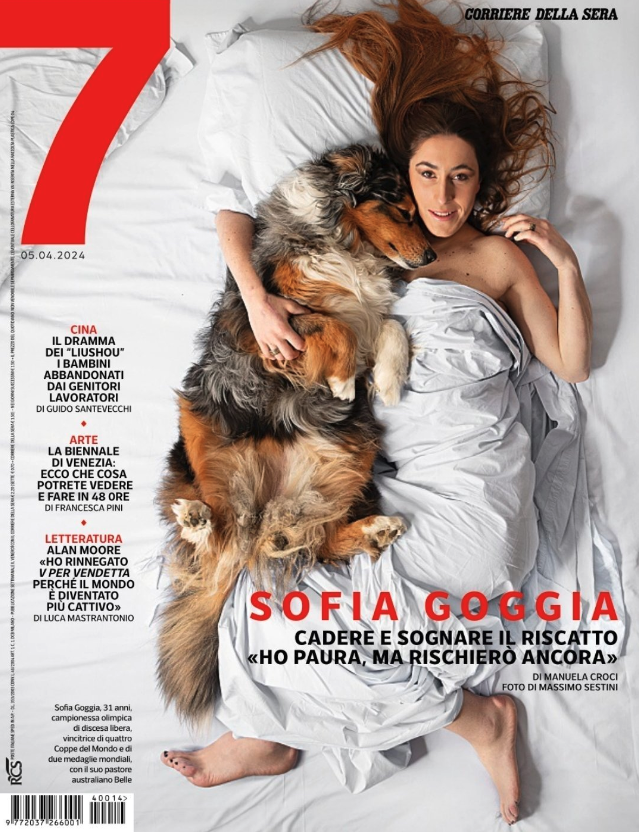
There is the photograph, and there is the image. In the case of this portrait of skier Sofia Goggia, the former is a mess that many have already weighed in on and that we will say little about here. The image, on the other hand, is — perhaps involuntarily — more interesting. In a single sentence, one might say that it recalls the past while at the same time marking a possible anticipation of the present.
n his Annunciation of 1472 (now in the Uffizi), a twenty-year-old Leonardo da Vinci elongates and disarticulates the Virgin’s right arm — an error of inexperience according to some, or, according to others, the deliberate result of a clever device: a kind of perspectival rotation, in which the viewpoint slides from the central position demanded by the scene to one that is lowered and shifted to the right of the canvas for the figures, taking into account the (probable) placement of the work above a side altar in a chapel.
About 550 years have passed since those brushstrokes. When the same span of time has elapsed from the clicks that produced this photograph and its clumsy post-production — if the image has survived the commentary that accompanied it — some semiotician may interpret the rendering of Goggia’s arm (also the right one), emerging from beneath the dog at an unnatural angle and suggesting a limb longer than its mirror twin, as a deliberate artifice to convey the woman’s capacity for control over nature (represented by the animal), which she once dominated the moment she strapped on her skis.
And if the same researcher remains unaware of the author’s awkward explanation, he will in all likelihood interpret the careless substitution of the right foot with a reproduction of the left as a knowing, polemical, and brilliant reference to images produced by Artificial Intelligence — which, in the early dawn of its arc (the period in which Sestini was working) frequently generated bodies with hands and feet rotated and swapped.
A gesture halfway between pop and Dadaism, one that would call into question the relationship between photography and “syntography,” and project this image into the gallery of great creative strokes alongside Duchamp’s readymades, Warhol’s Brillo Boxes, Kosuth’s installations, and Lichtenstein’s Brushstrokes.
And we, prisoners of the past with no hope of escape, will be unable to correct the error; unable to reveal that the awareness which transfigures the banal was, in this case, simply absent. That this image is not a meditation on pop conducted in pop’s own language — which is precisely what Pop Art is — but rather its unreflective byproduct: one that lacks the force to speak about the mainstream and is simply its flat, melancholically homogenized output.
Then again, who knows — perhaps Leonardo simply made a mistake when he drew it too.
The photographs and images on this page, in compliance with copyright law, are reproduced for purposes of criticism and discussion pursuant to Articles 65, paragraph 2; 70, paragraph 1-bis; and 101, paragraph 1 of Law 633/1941.
English translation based on Claude.ai translation services.