“Behind every window there’s a family or a human being, and you imagine, how did they live?”
The question with which Michael Wolf commented on his project Architecture of Density, dedicated to public housing in the city of Hong Kong, had already found, some forty years earlier, a response of great evocative power in Sibylle Bergemann’s project P2 – Wohnzimmer eines Häuserblocks.
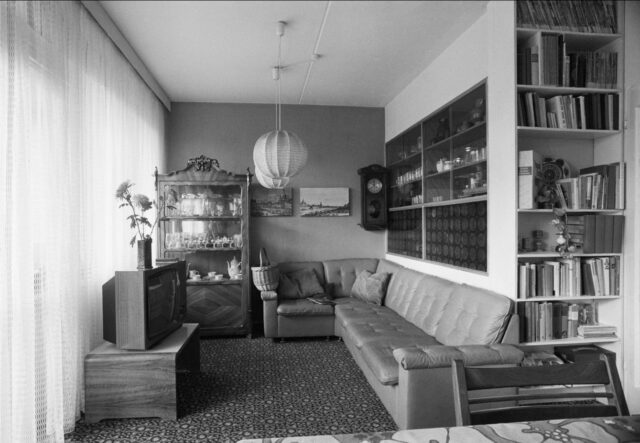
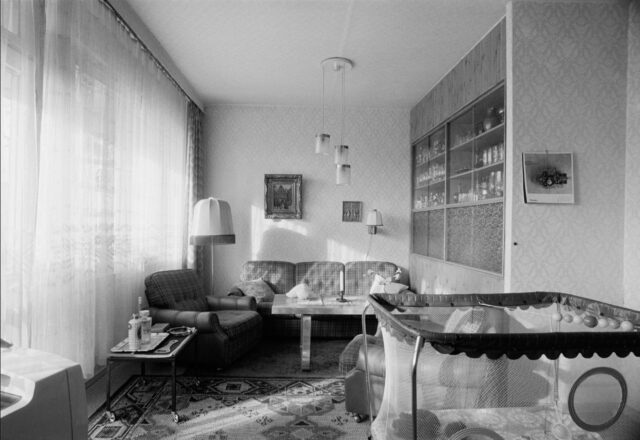
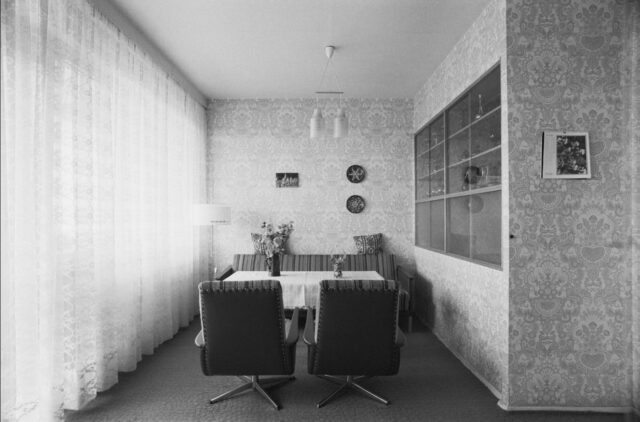
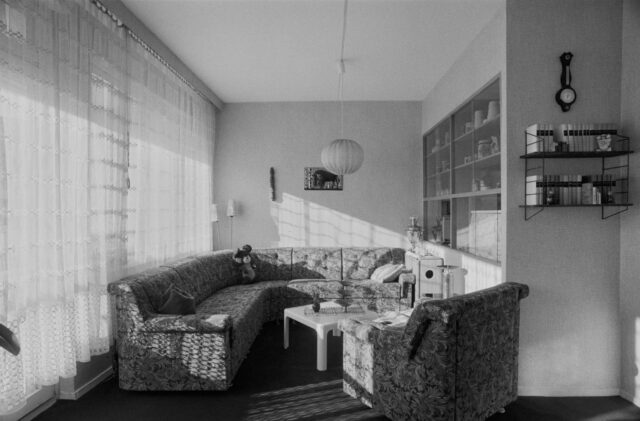
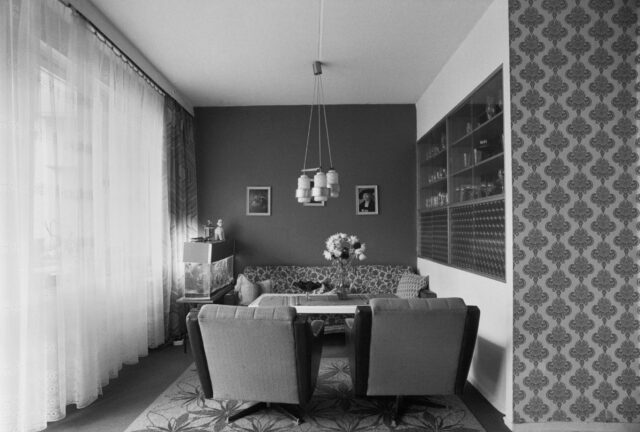
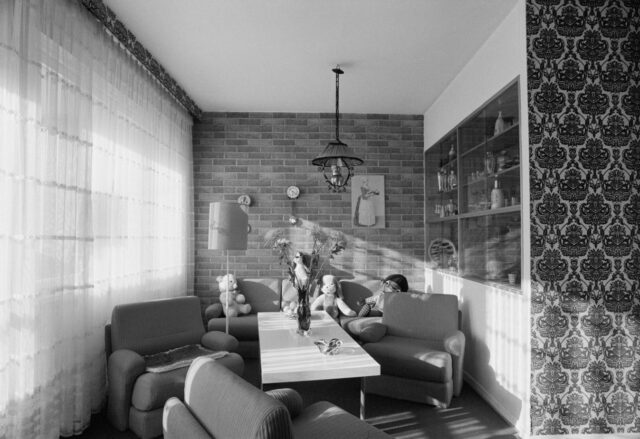
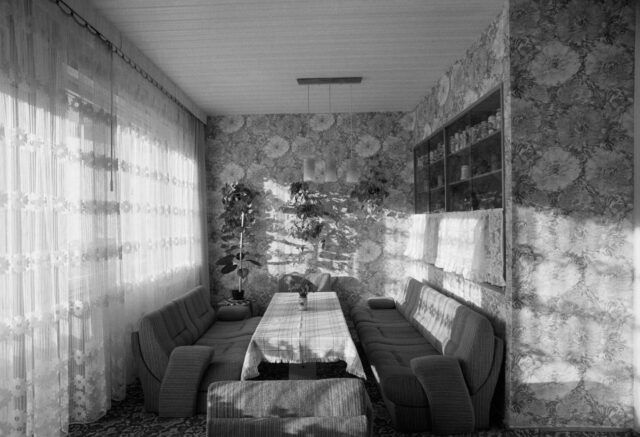
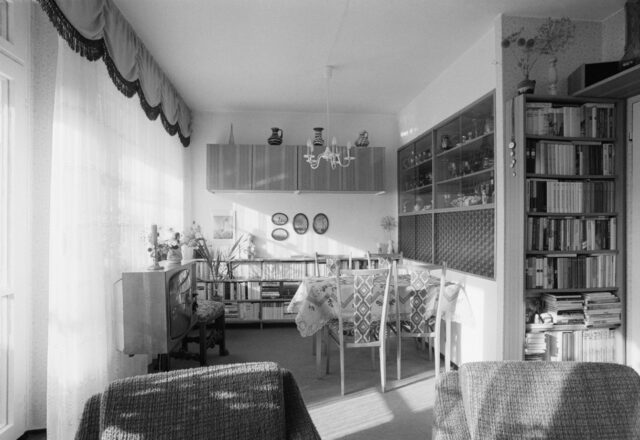
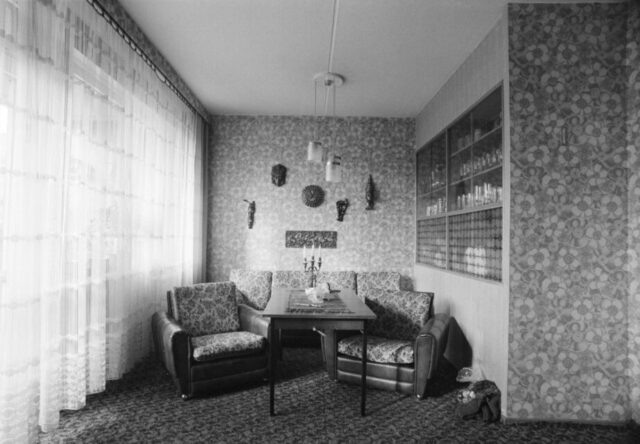
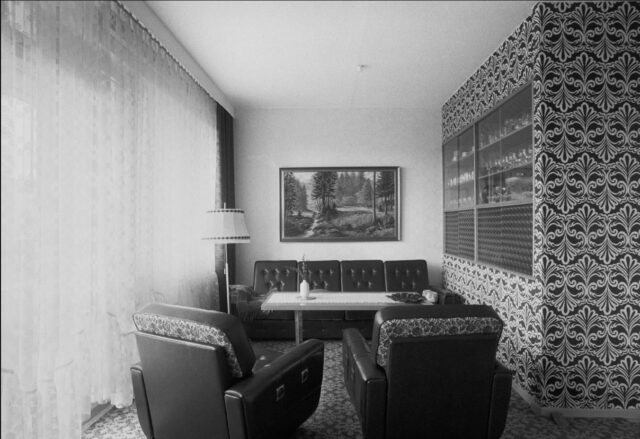
The Berlin photographer’s series takes its name from a complex of prefabricated social housing built in prestressed concrete in the early 1960s in the Lichtenberg district, in the eastern part of the city. Starting in 1974 and over the course of seven years, Bergemann knocked on the doors of ten apartments in one of the complex’s blocks and photographed their living rooms.
The result is extraordinary and, as tends to happen with projects from twentieth-century German photography, it is immeasurably greater than the sum of its parts. The interiors, identical as the display cases of a gallery — or, if one prefers, as the dioramas of a natural history museum — follow one after another, entirely deserted. To quote Roberta Valtorta, the inhabitants seem to have “fled the environment they themselves had built, migrated to an elsewhere that we are not given to see, perhaps dead.”
But, dystopian impressions aside, this absence is anything but a lack: one comes to realise, in fact, that photographing the rooms in praesentia of their inhabitants might have told us less, drawing our attention away from the details of the furnishings — from which we can intuit the number and age of the residents, read their tastes, observe their lifestyle choices, imagine their character.
Sibylle Bergemann (1941–2010) trained and developed her career as a reportage and fashion photographer outside the direct influence of the Düsseldorf School, yet in this project the typological approach that ran beneath the skin of twentieth-century German photographers is unmistakable. And no work of hers demonstrates more clearly how, in its utopian attempt to organise the world, Central European visual typology moves along the tightrope between what unites and what divides, between the need to impose order on the world and the contemplation of its irreducible variety.
English translation based on Claude.ai translation services.
The photographs and images on this page, in compliance with copyright law, are reproduced for purposes of criticism and discussion pursuant to Articles 65, paragraph 2; 70, paragraph 1-bis; and 101, paragraph 1 of Law 633/1941.