
Images know how to speak. According to the commonplace, each of them knows at least a thousand words. Perhaps we human beings do not always manage to decipher them all, but this does not seem to silence them. Not least because one of their most assiduous occupations is precisely that of speaking with other images. Every painting, drawing, or photographic frame — even those that spring directly from reality, or from that portion of it each of us carries within and which we call imagination — at the very moment of its conception and production inserts itself into a dynamic, multidimensional, and multiply connected network that binds it to the images from which it draws inspiration and to those it in turn contributes to generating. And through every one of these relationships flows a conversation.
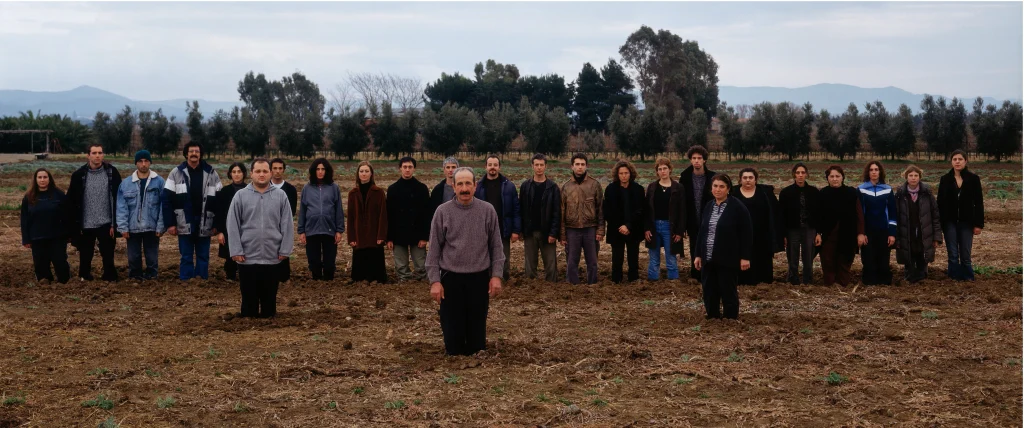
And often, just as in conversations, what matters — what stimulates discussion — are the differences each instance presents in relation to its model. I believe I can venture that anyone who has The Fourth Estate by Giuseppe Pellizza da Volpedo in mind will need only a quick glance at this photograph by Massimo Bartolini to have the illustrious ancestor called back to memory. And should the reference escape the viewer, notwithstanding the analogies and the title, the caption on the page dedicated to the work on the website of the Giuseppe Iannaccone collection is there to fix it in place — a caption also reproduced alongside one of the work’s four replicas currently on display until the end of September 2026 in the exhibition Tragicomica at the MAXXI in Rome.
And as is natural, the description concentrates on what distinguishes the two works — and it is interesting to note how the differences themselves take on a significance of their own. The website resolves them in terms of a reaffirmed bond between humanity and the natural environment, leading to a rejection of the “extremisms of progress” — toward which Pellizza da Volpedo’s crowds seemed to be advancing in their march — and a remaining anchored to the land to which these figures feel they belong, and to which they offer their stillness as a gift. This reference to symbiosis is echoed in the substitution of the infinite mass of people depicted in the painting with a row of trees that closes off a deserted space in the background. It seems, in other words, that in the depth the photograph develops, a metamorphosis unfolds not unlike the one Ovid stages in the flight of Daphne
Is this an interpretation that holds? Is this what Bartolini’s image replies to Pellizza da Volpedo’s? Anyone who encounters a reading is naturally called upon to engage with it, to share it or to argue its brilliances and its shadows. Which in this case, for the present writer, are in the majority. An attitude such as the one expressed in this critical reading ought to correspond to a proud, self-aware posture — one that monumentalises this stillness. And yet both the posture and the expressions are nothing more than neutral, and in the two male figures in the foreground they become positively subdued. These are figures that seem less planted in the earth than sinking into it, exhausted to the point of having abandoned every effort to continue the march in which the earlier image had caught them — a march toward the future, yes, but toward a time in which the demands of the multitudes might find a hearing, a future in which the conditions of life might be less wretched and more open to possibility. Nothing in Pellizza da Volpedo’s canvas spoke of a desire to withdraw from nature — a dialectic that, in the years when the painter set his canvas on the easel, was still in its earliest dawn. And nothing in this photograph seems to me to speak of a pacified return to the immobility of the condition of the labouring masses in the fields.
Likewise, the evaporation of the phalanxes of people in the passage from canvas to print does not seem to me resolvable in the equivalence — itself not a little dystopian — between human beings and trees. Here it is the absence of the masses in itself that carries a bitter meaning: vanished from representation because they have become unrepresentable. Perhaps they already were, at the dawn of the twentieth century; at the close of the first quarter of the twenty-first, their disappearance is simply a fact.
Perhaps what is needed is a work that would represent them once more — with dignity and conviction — that would remind us once and for all of their ineliminable presence in society and in the world. It would be a work we stand in need of. And I will venture to say it would be a true Work of Art.
The photographs and images on this page, in compliance with copyright law, are reproduced for purposes of criticism and discussion pursuant to Articles 65, paragraph 2; 70, paragraph 1-bis; and 101, paragraph 1 of Law 633/1941.
English translation based on Claude.ai translation services.