
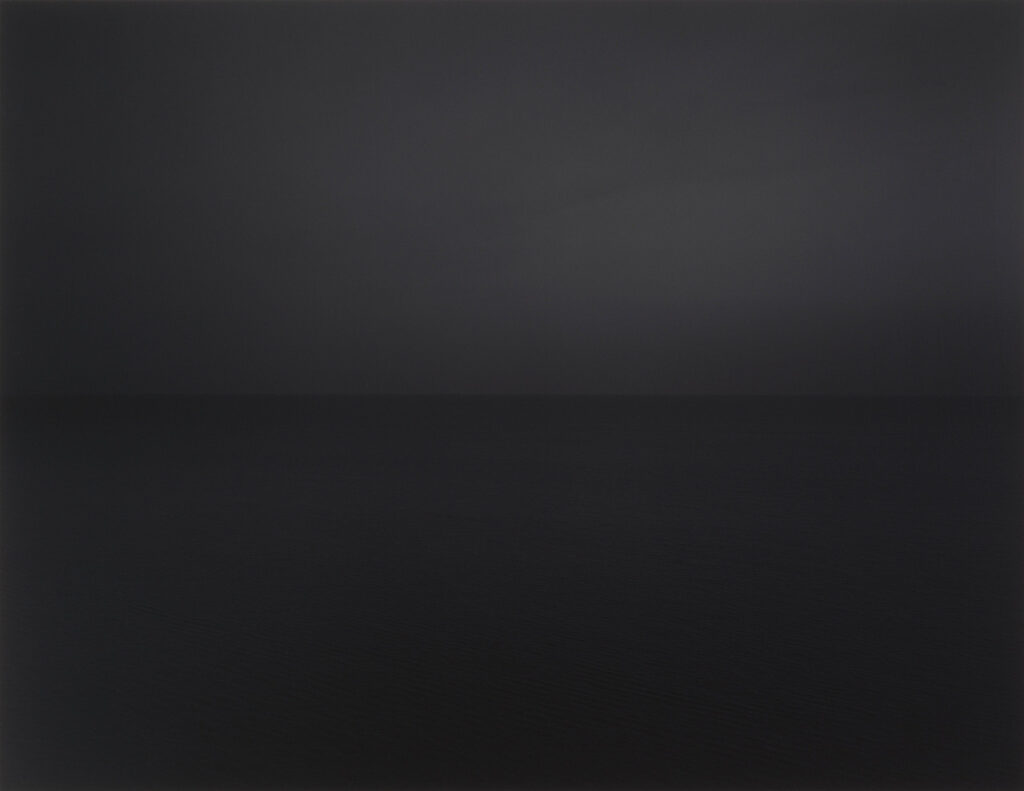
If, as Kant maintained, aesthetic experience arises from a free play of imagination and intellect, it is because within it the two faculties enter into a dialogue in which each brings an independent contribution — one that is, at times, at odds with the other. In the effort to find an accord, which we sense the work is calling forth, we are compelled to confront the distance between our mental “image” of a concept and the rational, cognitive knowledge we hold of it.
For instance, what our current understanding of the world allows us to say about infinity is that its color is black. There is a space — the one expanding beyond the last star — and there will be a time — when entropy consumes every usable form of energy — both impervious to all light. And yet, on the very same subject, imagination tells a different story: at its depths, infinity holds a light; the light emanating from the metaphysical being who imagined us into existence and will one day call us back, or, in more secular terms, the light that allows us to measure the “boundless spaces” the Wanderer fixes his gaze upon in the paintings of Johann Caspar David Friedrich.
Alongside the sight of the starry sky, the open sea perhaps remains the most common occasion for evoking infinity — the possibility of casting one’s gaze where there is nothing but the free expanse of sky and water, which at least in appearance seems to resist human colonization and set a limit to our trajectories, forcing them to halt at the water’s edge and leave exploration to sight alone. Yet sight requires light — the light the observer calls upon in order to be, as Ungaretti wrote, “illuminated by immensity.”
Hiroshi Sugimoto’s photograph of the Amalfi sea, like others from his “Seascapes” series, denies our vision precisely this attribute, placing us before the claustrophobic and infinite depth of darkness — the true color of the immense. To find illumination within it is an effort these frames demand of our faculties, not unlike what the defining canvases of the Rothko Chapel in Houston ask of us. A free play that, in speaking to us, lends dangerous concreteness — and perhaps even meaning — to our ancestral fear of the dark, which now risks appearing as the search for an exorcism against the infinite darkness awaiting us out there, beyond the last star.
The photographs and images on this page, in compliance with copyright law, are reproduced for purposes of criticism and discussion pursuant to Articles 65, paragraph 2; 70, paragraph 1-bis; and 101, paragraph 1 of Law 633/1941.
English translation based on Claude.ai translation services.