
What is meant by “iconic”? Certainly its most popular usage today has little to do with the one used on a semiotics-focused website, the latter being tied to the now-classic tripartition of the sign defined by Charles Sanders Peirce in the second half of the 19th century. None of that here: “iconic,” in its current meaning, is an adjective denoting something exemplary, capable of expressing to the highest degree the category to which it belongs. In the case of photography, it refers to an image’s ability to best represent the subject captured by the frame.
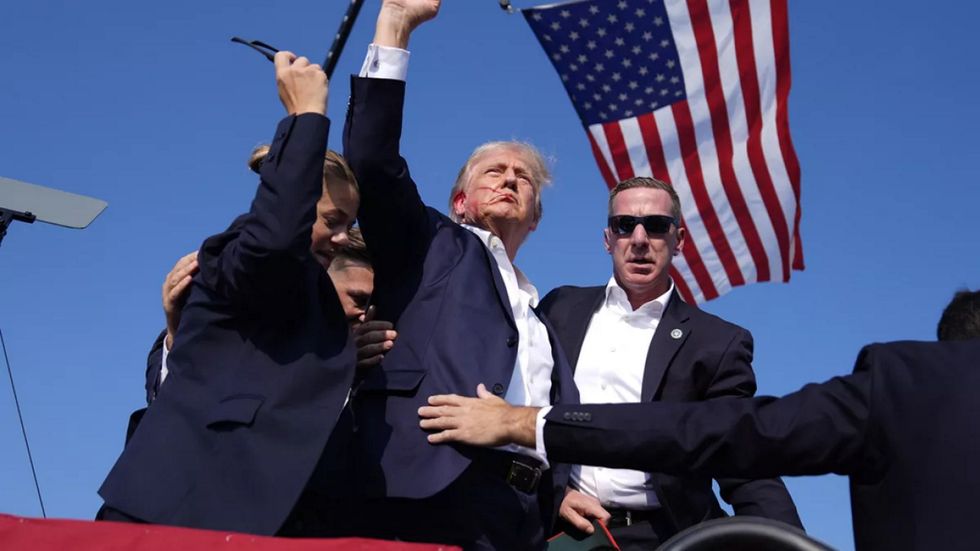
And so, just hours after the heavily media-covered assassination attempt on Donald Trump, this photograph by Evan Vucci has already claimed, among countless competitors, the title of the “iconic shot” of the event. And it is the speed of that attribution which is interesting, because it reveals that the iconic has more to do with the past than with the present or the future — assuming the latter is still a concept worth entertaining. We tend to label “iconic” a representation of a subject that returns it to a shared imaginary (understood as a collective visual encyclopedia) in a way that slots it smoothly into the structure we have assigned to that visual heritage.
And here everything is indeed in place to read the event in the way we expect: the American attachment to the flag, the stubbornness and self-assurance of the ultra-liberal American, the swirl of men in black surrounding the candidate. A pity about the bodyguard on the right looking directly into the camera, which drains the scene of pathos and immediacy.
All of this in a shot that freezes movement by organizing the scene into a perfect triangular structure, calling to mind similar and equally “iconic” images — such as Rosenthal’s famous photograph of soldiers raising the American flag on Iwo Jima. Though in that case it was a “second attempt,” with the soldiers lifting a new flag for the camera at the end of the battle.
Not that one wishes to push the comparison too far, giving ground to the conspiracy theories that have already begun to circulate regarding the attack on the Tycoon. What is being underlined here is that the “iconic shot” risks serving a normalizing — and therefore “anesthetic” — function, effectively preventing us from grasping whatever is new and unrepeatable in an event that is instead assimilated to something else with which it shares the same “icon.” In this era of photographic bulimia, one is left wondering whether this is precisely what a new kind of photography should be doing.
Or whether it might not be healthier to acknowledge that “iconicity” strips photography not so much of its share of realism, but of its verisimilitude. Bringing an event closer to the image we already hold of it, in short, serves its own reassuring function — not its capacity to help us read the present. Even at the cost of unsettling us.
The photographs and images on this page, in compliance with copyright law, are reproduced for purposes of criticism and discussion pursuant to Articles 65, paragraph 2; 70, paragraph 1-bis; and 101, paragraph 1 of Law 633/1941.
English translation based on Claude.ai translation services.