
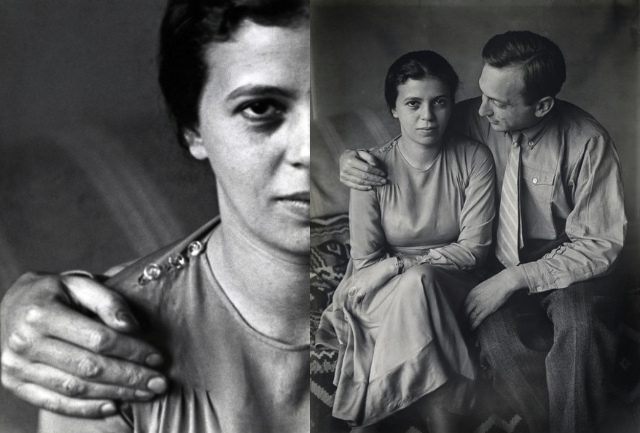
Context, Content, Form. If these were Cartesian axes, the analysis of a photograph would be a curve in the space they define. The shape and extent of the volume within which this line can move would be determined by the amount of information available for each dimension.
From time to time, however, it can be interesting to deliberately narrow the available space by limiting, in the analysis, the information relating to one or two of these domains.
For example, to assess the formal power of this celebrated shot — and of its drastic reworking twenty years later — it may be worth setting aside the contextual background of its production (an analysis based largely on that information can be read at https://medium.com/italia/elisabeth-e-io-5aad563663e), except for one detail — inferable from the title — namely that the author is the same person as the man portrayed to the left of the woman, who we may now assume to be Elizabeth.
By withholding direct eye contact with the lens, the man declares himself a bystander — that is, a character who observes the true subject of the work. The hand resting on her right shoulder, while in a plastic sense evoking an “encompassing-encompassed” relationship (which can convey both a sense of protection and of suffocation), takes on a figurative role as an indicator — an element pointing toward the gravitational centre of the scene. In essence, the man’s function seems above all to underscore the centrality of his companion, who, however, does not return his gaze; she fixes hers toward the camera and, one would be inclined to say, toward the viewer — that is, toward us. But between her and us there is also another actor: the observer, the entity whose gaze the image reproduces. In this case, though, we know that the role of the observer is embodied by the photographer himself — and so in reality, even without looking at the man to her left, she is staring at him through the lens.
The circle, seemingly open, closes and brings us back to the gravitational centre of the image: the woman’s gaze. A perhaps unintentional metaphor for human relationships, the embrace — somewhat stiff, in truth — deepens the shadow on the left side of her face and lends her an enigmatic expression, almost a veil of unease that the illuminated right side does not reveal, and which seems to freeze the reassuring look with which the man regards her. A sense of tension that projects onto the blur of the woman’s left hand and shapes its interpretation, heightening the impression of Elisabeth’s apparent discomfort — even if the parallel position of the man’s left hand suggests a sense of affinity and harmony between the two.
It is hard to say how far this analysis penetrates into the relationship between the photographer, André Kertész, and his companion. What is certain is that the striking 1962 reworking, together with the cropping of much of the frame, removes many of these elements; what remains is his hand as indicator, and from the gaze directed at the photographer only the illuminated portion survives — which on its own produces an expression of greater openness. A less ambiguous version, one that brings to light a detail easy to overlook in the earlier one: the three buttons of her dress, a bridge between the hand and the face — an element that seems to lend dynamism to a gesture otherwise devoid of it.
The photographs and images on this page, in compliance with copyright law, are reproduced for purposes of criticism and discussion pursuant to Articles 65, paragraph 2; 70, paragraph 1-bis; and 101, paragraph 1 of Law 633/1941.
English translation based on Claude.ai translation services.