
“Photography […] appeals to the sense of power that accompanies our attempt to order and construct the surrounding world.” By the mid-1990s, when Graham Clarke was writing these words, mobile photography had not yet exploded onto the scene, and perhaps it was not obvious to foresee that, before long, our very instrument for ordering the world would itself need to be organized.
Today the “Fury of Images” is such that it risks overwhelming us if we do not attempt to harness its flow through a system of embankments. We have entrusted this new role to what, in an expression already worn smooth by use, we call “iconic images” — exemplary representations that have become the nodes of a multidimensional grid, within whose mesh we seek to channel the inarticulate chaos of images that reach our perception.
And even if, for reasons of convenience, an image that dissolves into an icon to the point of being subsumed by it is useful for our taxonomic capacities — since it allows us to save cognitive resources in managing it — the dangerous images, those that seem to challenge the icon and call its role into question, turn out to be the most interesting ones.
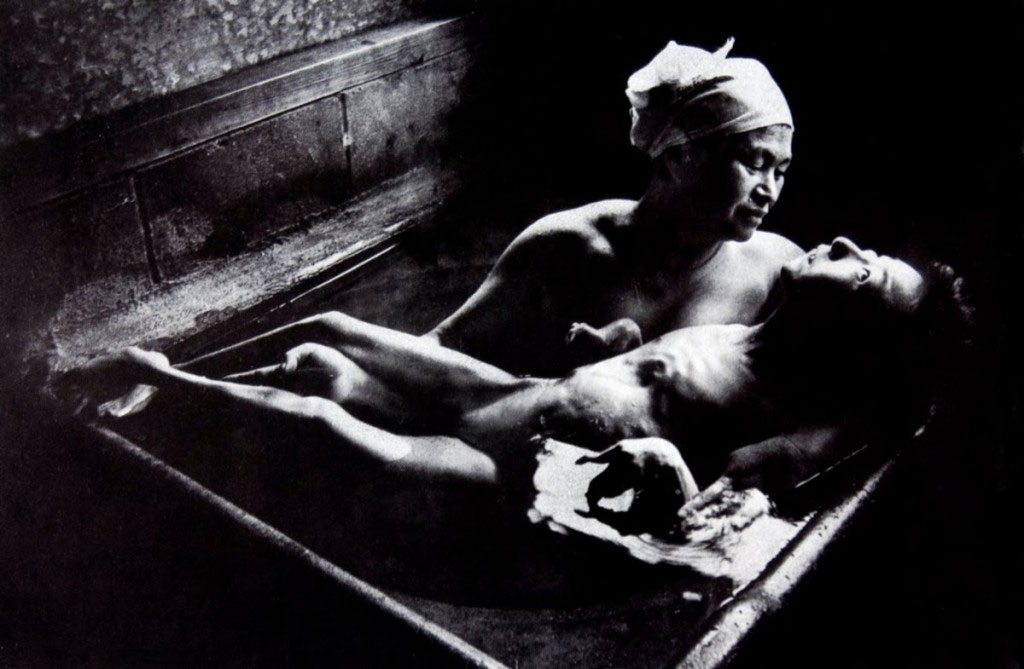
The photograph depicting a Japanese woman bathing her daughter Tomoko — rendered paraplegic by the methylmercury that poisoned the waters around the village of Minamata — is often described as the “Pietà of the twentieth century.” The comparison invokes one of the best-known images in Western culture, carved in Carrara marble by Michelangelo Buonarroti between 1497 and 1499. But despite the fame and importance of its reference icon, this photograph simply refuses to be a mere instance of it.
Let us begin with the points of contact, those that justify the parallel: certainly the overall compositional structure and the familial relationship between the protagonists of the representation. Among the correspondences I would not include the condition of the recumbent figure, because while Christ is dead, Tomoko is still alive — albeit condemned to a life of suffering and difficulty, of which the contracted posture of her body bears witness, as does that claw-like hand that Smith made the sole protagonist of another shot of absolute beauty. The grief of the Virgin is, in sum, an acute grief, which Buonarroti tempers into a kind of Olympian sadness, in keeping with the Apollonian rhetoric of the Renaissance. That of the Japanese woman we may imagine to be of a more chronic kind — dull, continuous, made of anguish for the present and dread for the future. And here the American photographer’s rendering is extraordinary: all these feelings — and it is hard to imagine they do not crowd a mother’s heart — are sublimated in a gaze that radiates pure love, the selfless and invincible love of mothers, a tenderness that is, if anything, amplified by the fact that the daughter’s gaze does not meet her mother’s, to the point that one may legitimately wonder whether Tomoko is even aware of her presence. But, as we know, only a mother’s love has any chance of attaining a pure form — one that feeds on itself and asks for no reward.
An inexhaustible capacity for affection that Rilke imagined radiating from the eyes of the mother of Malte Laurids Brigge:
Oh, mother: the only one who arranged all this silence differently, in childhood. Who took it upon herself, saying, “Don’t be afraid, it’s me.” Who had the courage to personify it in the night for those who feared it, for those who were mortally distressed by it. You light a lamp, and the noise is already you. And when you hold it before you, you call out: “It’s me, don’t be afraid.” And when you set it down slowly, there is no longer any doubt: it’s you, you are the light around the familiar and friendly things, which, free of indecipherable meanings, stand, good, simple, clear. And if something runs along the wall or moves a step in the loft, you only smile, smile, smile translucent against the bright background toward the frightened face that looks into yours, as though you and every muffled sound were one, by secret understanding.R.M. Rilke, The Notebooks of Malte Laurids Brigge, 1910
Perhaps this would be the right place to close, but the remarkable passage just quoted prompts one final analytical observation: in Rilke’s nocturnal scene, the power of the mother’s gaze merges with light — the same light that illuminates — or rather, one is tempted to say, emanates from — the face of Tomoko’s mother, spreading and amplifying itself across the daughter’s face; a brightness rendered all the more radiant by the symphony of shadows that Smith has constructed around it. Arthur Danto once asked whether shadows belong to the statues upon which they fall; in photography, at least, that doubt does not arise.
The photographs and images on this page, in compliance with copyright law, are reproduced for purposes of criticism and discussion pursuant to Articles 65, paragraph 2; 70, paragraph 1-bis; and 101, paragraph 1 of Law 633/1941.
English translation based on Claude.ai translation services.
[Commento al post Facebook di Angelo Raffaele Turetta]
Non ho mai troppo volentieri paragonato questo capolavoro di Smith all’altro sublime capolavoro del Buonarroti, il paragone viene a mio parere dalla postura della madre con la povera Tomoko e dagli sguardi simili, anche la bambina ha lo stesso del Cristo morto. Smith vide la scena nel bagno della casa, non contento fece costruire la vasca illuminata caravaggescamente (perdono per il vocabolo) in uno spazio buio, la madre entrò nell’acqua e qui cambia la storia, l’acqua simbolo di nascita e non di morte, e il punctum di tutta l’immagine la mano rattrappita di Tomoko sapientemente stagliata sul riflesso e lo sguardo della madre non di dolore ma un accennato sorriso di amore. Un mio punto di vista. Saluti