
Take a pane of glass the size of half a royal folio, and fix it firmly before your eyes, that is, between the eye and the thing you wish to portray; then place yourself at a distance of two thirds of a braccio from the said glass, and fix your head with an instrument so that you cannot move it at all. Then close, or cover, one eye, and with a brush or chalk pencil mark on the glass what appears beyond it.
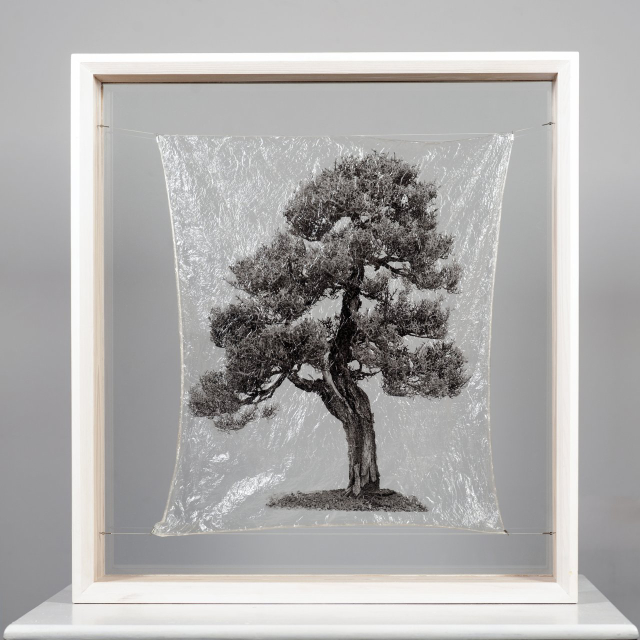
Let us imagine that, having followed Leonardo’s instructions for reproducing a scene, we managed to slide out the pane of glass on which we had just drawn and leave suspended the veil of the drawing we had just laid down. We might find ourselves looking at something very close to the frames of the works Andrea Pacioni produced between 2017 and 2020, spreading emulsion onto tempered glass and lifting it from the support after exposure.
An image visible from both sides of the extremely thin surface, which hovers within a “frame-window,” held by slender steel wires, and which questions us about the relationship between representation — which in its striving toward perfection seems to aim at a diaphanous consistency — and its support. How far does this operation bring us toward the essence of the image? Stripped of its material backing, does the image truly become a pure optical phenomenon? Does something artificial remain even in a mimetic representation of impalpable thinness?
We are probably in one of those cases where the answer is not contained within the question — it is the question. If the work prompts the viewer to ask questions not only about what is represented, but also about the very modes by which representation is enacted, we have not yet reached the point at which imitation merges entirely with the thing imitated. Assuming, that is, that achieving such an overlap is actually possible, and that its achievement — which would coincide with a point of no return for Art — is an interesting and desirable event.
In short, however thin it may be, a representation of a cypress always contains something different from what exists in the cypress itself. In its synthesis of poiesis and techne, of conceptual force and aesthetic rendering, Pacioni’s work does not appear to be an attempt to approach the limit so much as a story about the game and its stakes. And it is telling that this story unfolds within the territory of a discipline that has always found its technical and ontological foundation in its indexical relationship with reality.
The photographs and images on this page, in compliance with copyright law, are reproduced for purposes of criticism and discussion pursuant to Articles 65, paragraph 2; 70, paragraph 1-bis; and 101, paragraph 1 of Law 633/1941.
English translation based on Claude.ai translation services.