
Each of us, whether we like it or not, has an aesthetic criterion of our own. And inevitably part of that criterion consists of the properties an object must possess in order to attract our interest and trigger the “free play of [our] faculties.” The “sensation” this play produces in us is what, for the sake of brevity, is called “aesthetic experience.”
My late father, God rest his soul, was a cabinetmaker and marquetry artist who, despite repeated assaults, never managed to scale the wall separating him from the territories of art. His criterion was “size.” In the physical sense of the word: grandeur in an artefact was a quality that fascinated him and captured his attention. What then happened to his faculties I don’t recall ever knowing, but that, after all, is another story.
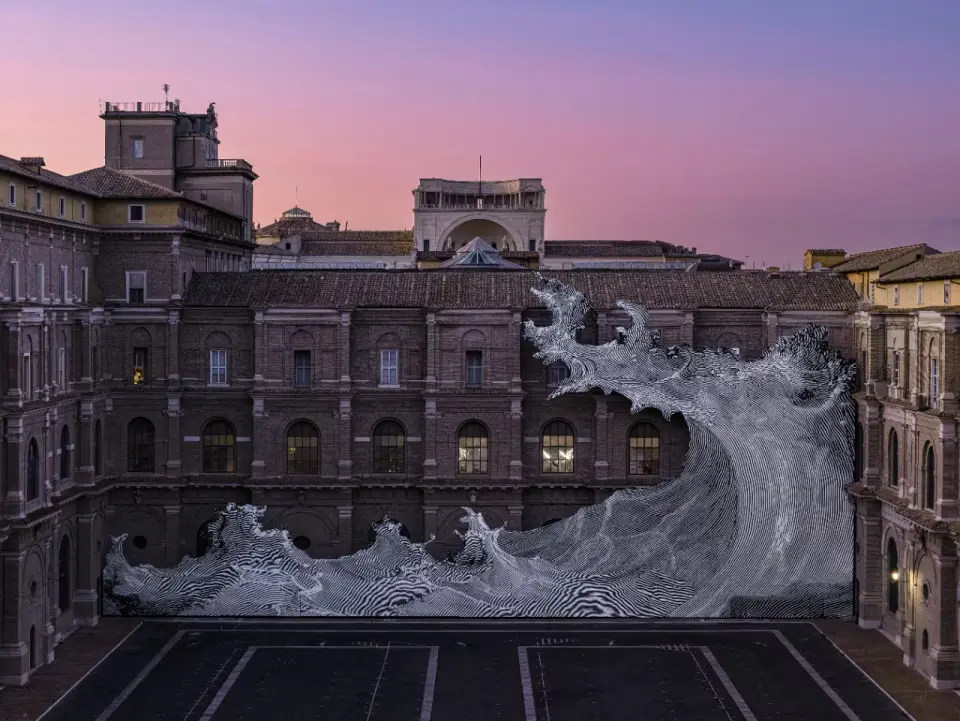
One wonders, though, what he would have made of this mania for immersivity, for the work that must tower over and envelop the viewer. I do know what I make of it, however, and the installation Diluvium — the monumental backdrop that Jean René (aka JR) has placed in the courtyard of the Apostolic Library in the Vatican — represents my opinion fairly completely, in the sense that it argues the case for it, even though I suspect it does so involuntarily.
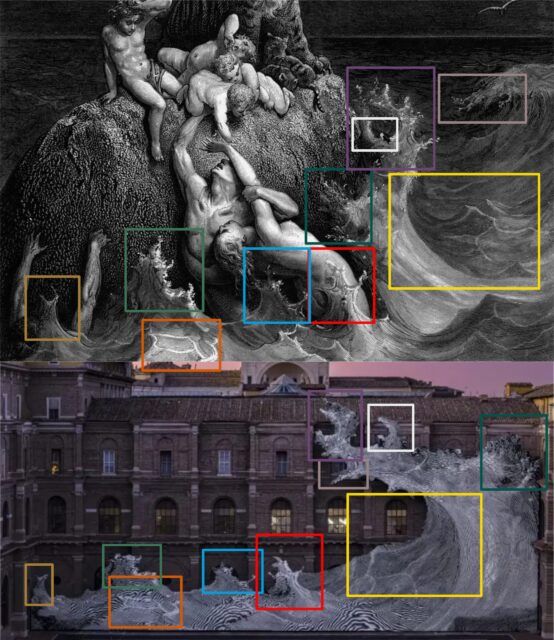
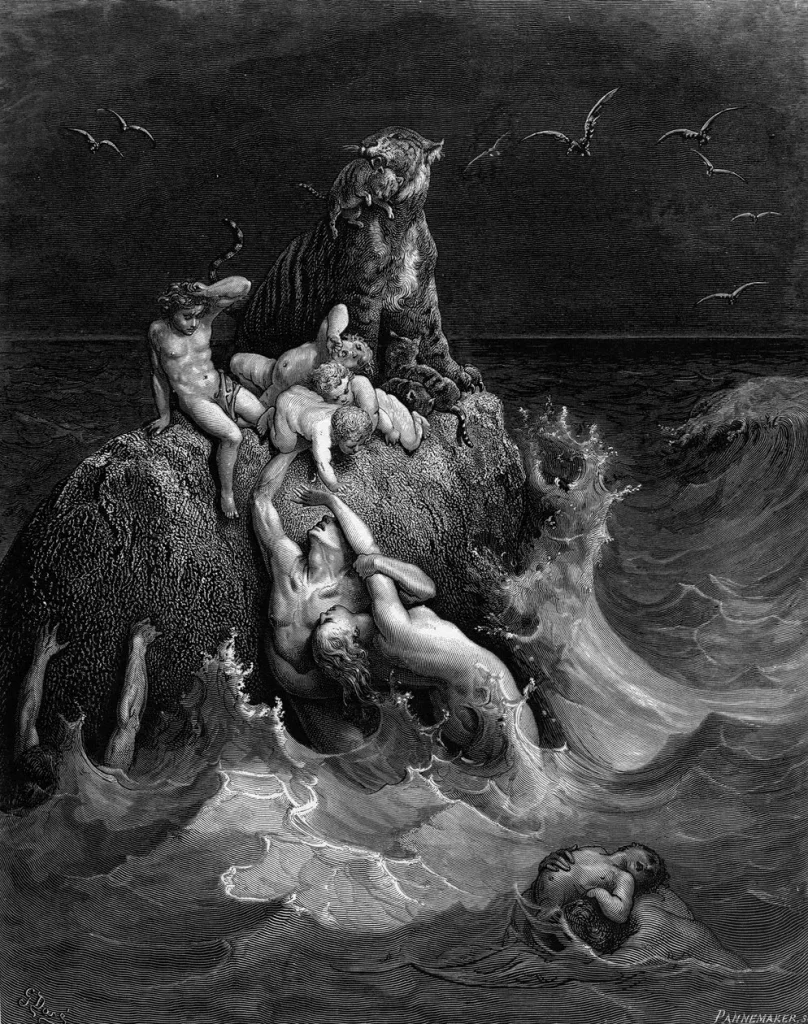
Now, before describing this large frayed sheet as a work by JR, one ought to hear what Gustave Doré has to say about it, given that it is essentially a cut-and-paste of the etching dedicated to the Great Flood in the edition of the Bible he illustrated in 1865. My graphic analysis makes the borrowings plain.
Someone has also invoked Hokusai’s Great Wave, which in my view has nothing to do with the matter, except insofar as it comes to everyone’s mind as the most famous representation of a wave currently in circulation.
But this secondhand iconography allows us to get to the heart of the problem. That one work should call another to mind is perfectly normal. The moment we cast our gaze upon an image, a network is activated in the mind of which Aby Warburg’s Mnemosyne can give only the vaguest suggestion; the point is that within this web one must find one’s bearings and retain only the threads that are of use. And notoriety may be a criterion for assembling a reality show — not for establishing the connections appropriate to a critical approach.
Otherwise, in this visual minestrone, our aesthetic capacity does not swim but drowns, like the figures in Doré’s engraving. And once submerged in the ocean of anything goes, with its lungs full of representations that have nothing to do with what we are actually looking at, this faculty takes no time at all to turn into its opposite: an “an-aesthetic” torpor in which every stimulus dies out in the sensation of having already felt it all before. An anaesthesia from which one of the most immediate devices for jolting the viewer and stealing a minimum of simulated attention is, precisely, monumentality.
Personally, Doré’s plate does not thrill me, but it certainly conveys everything that JR’s scaffolding cover conveys — and I shall return to this presently — only it does so within the space of a single page. A measure too small, a voice too thin, to stir our torpid experiential dispositions.
But if size is an all-too-overused device, that does not mean there are not cases in which it can be deployed with artistic effects worthy of interest. In short, before stigmatising the work’s imposing scale, it is worth questioning the rationale behind JR’s piece.
IThe press releases tell us that it is the “front artwork” for the exhibition AQVA. Catastrofe e meraviglia, which is itself part of an articulated exhibition project that over the course of five years will address the threats endangering our bibliographic heritage.
The first risk likely to spring to mind is fire. It is the means to which the blind Jorge resorts in order to carry out his plan to destroy the phantom second book of Aristotle’s Poetics, and the same to which Herostratus turned when he set out to destroy the Library of Alexandria in the colossal act of vandalism that delivered him his wretched fame.
But water has done its share of damage too: one need only think of the Florentine mud that swept through shelves and deposits exactly sixty years ago — an anniversary which, it seems, is entirely coincidental; after all, we are still talking about a foreign state. But does this wave crashing against the walls of the Vatican Library, like a Pantagruelian glass shaken by a giant, truly speak to us of the danger that water poses to our culture and our civilisation — above all as rising oceans and Mediterranean monsoons transform the car-park courtyard into a swimming pool?
Perhaps. To me it gives the impression of an element bridled, of a threat mastered, whose funfair allure diminishes rather than amplifies it. And in any case there is a theatrical dimension that imposes the frame as an inescapable element of confinement and devitalisation.
In short, the ludic element is far too pronounced to work. Unless things are more subtle, and the message to be deciphered lies precisely in the reference René has chosen. Gustave Doré’s waves are not just any waves: they are the instrument of divine punishment — punishment for the wickedness of man. This, then, is a water that is there to condemn human hybris: and very often knowledge — the kind preserved by libraries — has been a source of boundless pride in man, who has used books as the rungs of an immense Tower of Babel with which to threaten the glory of the Lord. In a certain sense things still stand this way, though in all honesty it seems to me that the stock of that kind of knowledge is falling. The otherworldly commands precious little interest on the whole, while the immanent is the true terrain of conquest. The moral might be that, like so many pocket-sized Midases, human beings will end up swallowed by the very matter they seek to appropriate in order to dominate the world and one another. Perhaps behind this forthcoming catastrophe lurks precisely that divine dimension we have erased from our horizon, deploying thoroughly material punishments for our material sins.
But then the question that might provocatively arise before us, standing in front of JR’s die-cut mega-poster, is: why on earth should the flood begin at the Vatican? Could it be that JR is, at heart, an irreverent Jacobin?
The photographs and images on this page, in compliance with copyright law, are reproduced for purposes of criticism and discussion pursuant to Articles 65, paragraph 2; 70, paragraph 1-bis; and 101, paragraph 1 of Law 633/1941.
English translation based on Claude.ai translation services.