
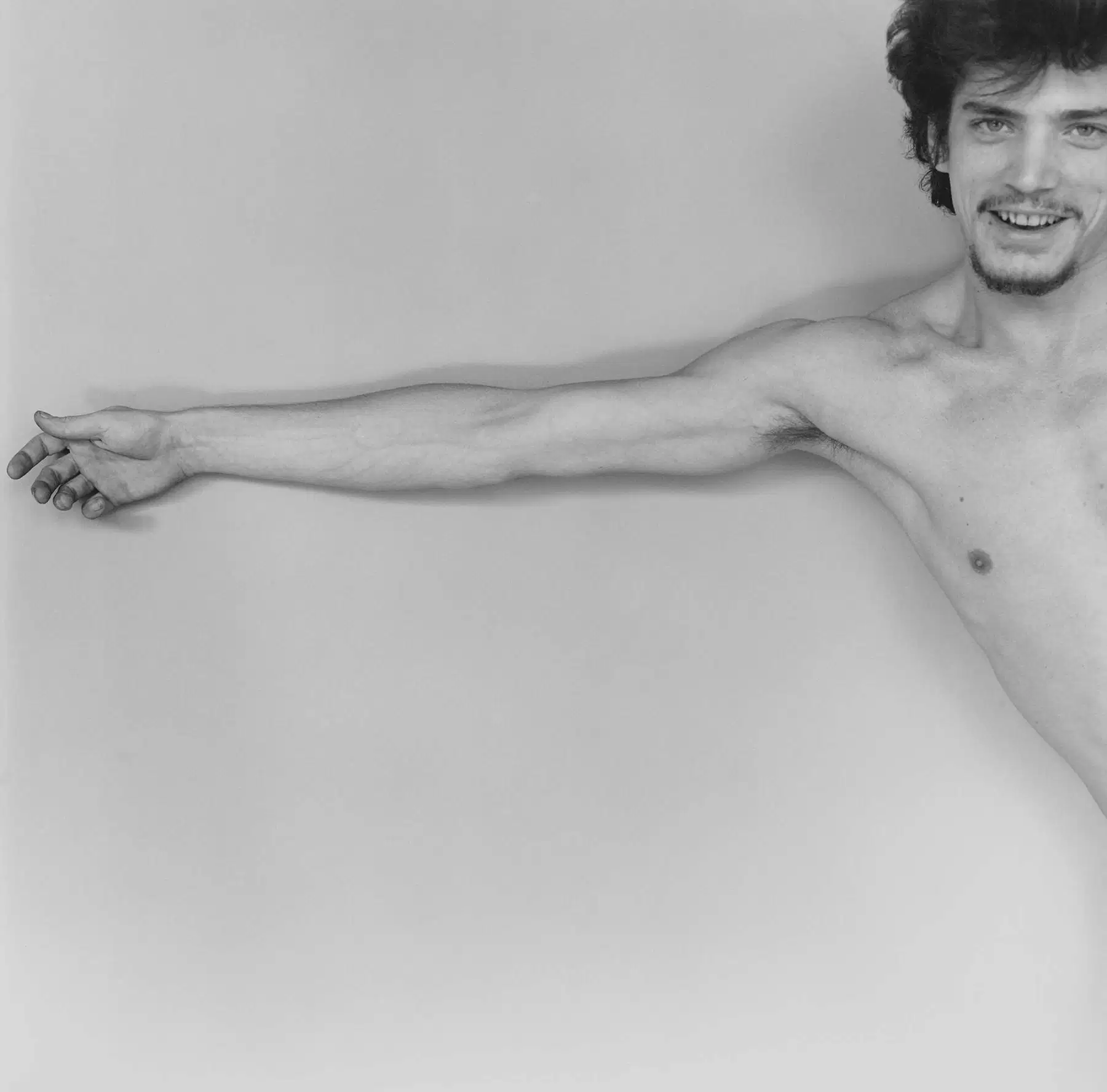
In Italy — elsewhere I couldn’t say — photography has declared war on beauty. And the unsuspected truncheon-wielder against the aestheticisation of the photographic artefact is none other than goodness. Ever since the by now overly repeated anecdote of the first meeting between Mulas and Berengo Gardin, the thoughtless utterance of the expression “beautiful photograph” has become the instant prelude to a bitten tongue and a raised eyebrow among those listening.
From here the question is inevitable: where should one place Robert Mapplethorpe in this universe of “ugly but good” that photography has become, according to the Italian vulgate? Le Forme della Bellezza (The Forms of Beauty), the title of the recent exhibition dedicated to him in Rome, speaks plainly. Here one strolls immersed in the beautiful, presented in formal arrangements that seem the hypostasis of the arguments Robert Adams set out in his essay “Beauty in Photography.”.
And that Mapplethorpe had a diviner’s eye for beauty we can see in the exemplary portraits of a young Patti Smith, in which an entirely feminine sweetness is almost magically conjured from the androgynous features of the American singer-songwriter.
Besides, he was himself a handsome man (one wonders whether our home-grown photographers would at this point wrinkle their noses, preferring to call him a “good man”), and the self-portraits that open the show are in perfect accord with the harmonies of bodies and flowers lining, until the first days of October 2026, the walls of the exhibition space at the Ara Pacis. Subjects already beautiful in themselves, exalted in their allure to the point of becoming impervious to the touch of irony that here and there intervenes to ruffle the perfect syntax of the images.
Personally — the champions of “photographic goodness” will forgive me — I find nothing wrong in pursuing beauty, in ferreting out the harmony of the world and fixing it in an image: in this case, however, this massive dose of splendour and charm prompts me to ask questions. And I find some cues not in the prints but in the captions, where I discover that almost all the shots date from the 1980s. Anyone in the mood for forgotten expressions will remember them as the “years of the retreat” when the propulsive role of public opinion in determining political choices lost its energy, running aground in the shallows of the dissipation brought by widespread prosperity, lulled by the idea that one could finally relax and close the short century by passing from street marches to spritzes.
On the plane of taste, this triumphant and catastrophic entry into postmodernity led to the expulsion from the aesthetic horizon of the ugly, the deformed, the problematic — in a word, of everything that Adorno’s Aesthetic Theory had set in the sights of art. And indeed, looking at these splendid images, the pertinent question is: wherever has ugliness ended up? It is too easy to say that it is all around us; if art — assuming photography is one — wants to be more than a recreational moment and to become an instrument for making sense of ourselves and the world we live in, it cannot evade whatever in the world and in ourselves is unpleasant and perverse.
Mapplethorpe’s photographs, at least those on show, are fully inscribed in this descending phase of Western civilisation. Whether they will have the strength to survive the circumstances of which they are a symptom, who knows. Another couple of hundred years and we shall find out.
Returning to the present, there remain the portraits of famous figures, where handsomeness — when there is little of it; I cite from memory Leo Castelli and Truman Capote — is made up for by fame and authority. These remain the most interesting frames in the series, even if personally I cannot help adoring the stupendous Flowers.
In conclusion, a couple of lines on the photographs taken in Italy, which strike me as little more than a wink at our irreducible home-grown provincialism, still accustomed to attributing a specific value to whatever concerns it. They retain the ability to sculpt images into a stunning, plastic three-dimensionality (the diptych of the Faraglioni of Capri belongs in an encyclopaedia), but the polished Yankee sensitivity to beauty, and its idiosyncratic leaning toward the intrinsically glossy, tends somewhat to plane away the specificities of the genius loci.
The photographs and images on this page, in compliance with copyright law, are reproduced for purposes of criticism and discussion pursuant to Articles 65, paragraph 2; 70, paragraph 1-bis; and 101, paragraph 1 of Law 633/1941.
English translation based on Claude.ai translation services.