
To provide examples of the punctum,
means, in a certain sense, to yield.
R. Barthes
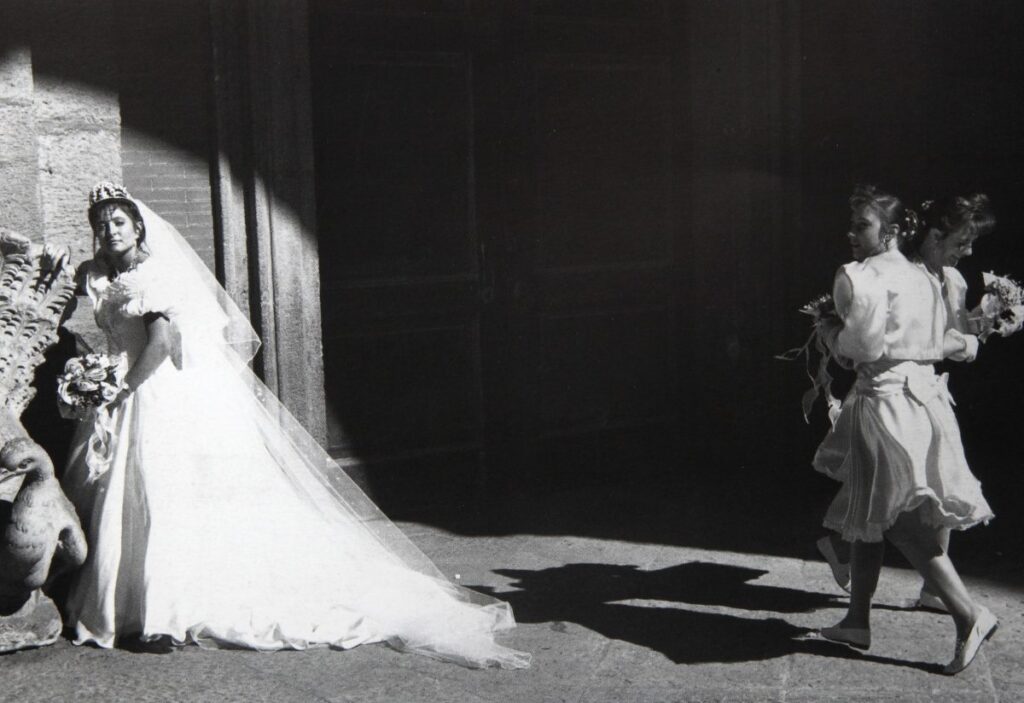
To use Roland Barthes’s own words, photographic analysis ought to be the domain of the studium. In the search for semiotised, culturally stable elements, one constructs a possible path of readings capable of being communicated and, to some degree, shared. And yet from time to time it happens that the punctum — the element that, “rising from the scene, pierces” — catches the gaze off guard, seizes it with its magnetic force, and sets vibrating strings that are more intimate and personal within the spectator. It is then difficult to resist the temptation to recount the sense of wonder the image arouses, venturing across the irreducible distances that separate us from the most inaccessible regions of our fellow human beings.
In this image by Oreste Pipolo, what strikes me — and the personal pronoun is impossible to forgo here — is the soft, plastic, finely incised drapery of the dress worn by the little girl on the right. A draping that carries the same lightness as the suspended step that sets it in motion, and that seems to have come fresh from the brush of a Lorenzo Lotto — to whose metaphysical vein the entire group on the right can, on closer inspection, be referred, the two little girls appearing almost as though one were the reprojected reflection of the other, like a childhood variant of the Venetian master’s Portrait of a Goldsmith.
From here — from this almost supersensory weightlessness that remains for me the gravitational centre of the frame — the eye moves leftward: a shadowed field, in which a heavy closed door can be glimpsed, separates the lightness of life’s springtime from the matronly, grave, incandescent figure of the bride, leaning against the tail of a peacock statue that stands in for the husband with the symbolic metonymy of the pride which, to judge by her expression, the woman appears certain she will inspire in her spouse. A distracted and inanimate peacock might, for more than one reason, serve as an allegory for the groom on his wedding day; nothing seems more likely than that its presence is a stroke of Pipolo’s inexhaustible irony. And who knows whether it is by chance that the backdrop to the bride is a vertical row of bricks, which might seem to evoke the role that awaits the woman in the forthcoming daily life of the couple.
From here — from this weave of brick and tufa — the dazzling ridge of the dress carries us toward the two shadows: two patches on the gleaming paving stones that, like a path that is for more than one reason dark and therefore mysterious, lead me back to the extraordinary pair who once again, unfailingly, hold me in their spell.
The photographs and images on this page, in compliance with copyright law, are reproduced for purposes of criticism and discussion pursuant to Articles 65, paragraph 2; 70, paragraph 1-bis; and 101, paragraph 1 of Law 633/1941.
English translation based on Claude.ai translation services.