
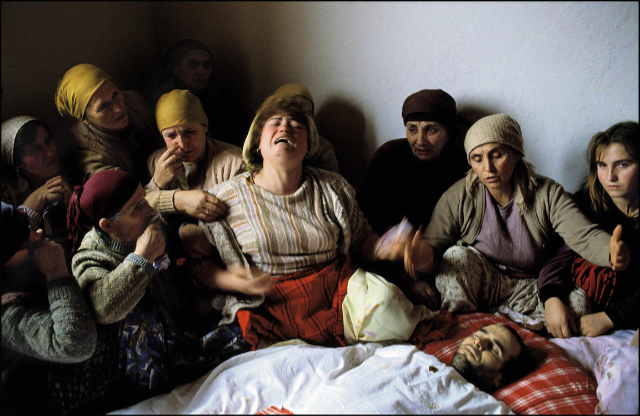
Who knows how we would see this image, what we would look for in it and what we would find, had we never seen a painting by Caravaggio, Velázquez, or Rembrandt. If culture is what we place between ourselves and the world, its organisation into paradigms inevitably ends up structuring our very idea of reality. And, naturally, the optical dimension of our shared knowledge is no exception to this role; the visual culture of a civilisation at a given historical moment can be leafed through in the pages of a catalogue of exemplary images that come to represent its way of seeing the world.
In the case of photography, this kind of membrane enters into an as interesting as it is problematic dialogue with the medium’s presumed vocation for restoring the immediate fragrance of things. The reproduction of reality always ends up reproducing, in part, our way of perceiving it; indeed, beyond its technical construction, the difference between a predictable image and an incomprehensible one lies partly in the degree of opacity with which the reference to the canon is realised.
In this image by Georges Merillon, the theatrical staging, the wings swallowed by shadow, the diagonals formed by the heads and hands of the women converging toward the dead young man – the very elements responsible for the empathic power of Caravaggio’s compositional syntheses – threaten the emotional charge of the frame at the same moment as they reinforce its aesthetic qualities.
The sensation of being confronted not with grief itself but with a representation of grief is so strong that one risks lingering in reflection not on the weight of desperation and suffering, but on the rhetorical properties of the shot.
To the point of noticing that even more archaic references have found their way in: the multiplication of figures through the rotation of a single module, as occurs here in the case of the three mourning women who raise a handkerchief to their faces with the right hand – a device we find in the history of art in proto-Renaissance examples such as the Legend cycle of Piero della Francesca or the panels of Perugino and the early Raphael.
To what extent, and under what conditions, this accumulation of references allows the immense tragedy of the Kosovar people to pass through – and with it the still more universal tragedy of a mother who finds herself weeping over her own son – is a question that calls into account not only the success of a single image but, perhaps, the way in which an entire photographic genre is summoned to interpret its role.
The photographs and images on this page, in compliance with copyright law, are reproduced for purposes of criticism and discussion pursuant to Articles 65, paragraph 2; 70, paragraph 1-bis; and 101, paragraph 1 of Law 633/1941.
English translation based on Claude.ai translation services.