
Tertium non datur. It may be a matter of millennia-old habit, but it is no simple thing to say whether Aristotelian logic speaks of the world or of a representation of it. What is certain is that there exist representations which follow this logic in their own way, when they do not outright contradict it – even if their departures frequently escape our eyes, conditioned – or perhaps it would be more apt to say, reassured – by a vision of the world that guarantees us that things either are or are not.
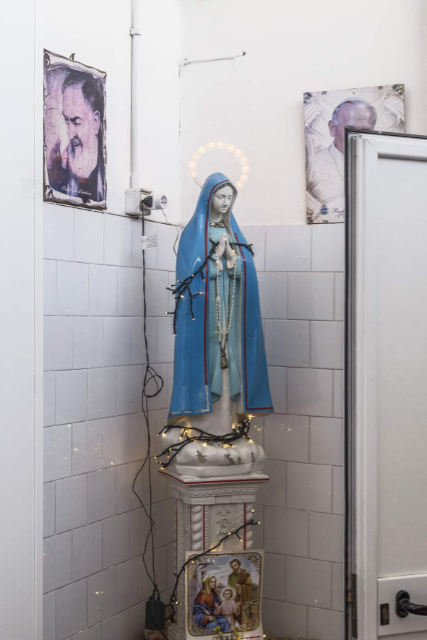
Take the case of images, and of photography in particular. And take the property in which they are most invested, namely visibility. Anyone might say without much hesitation that what is seen in a photograph is visible. But can we be sure that the only way to deny a subject’s visibility is to exclude it from the frame? Or might there be the possibility that the image manages to negate what it stages? One such path might be the capacity to bring different, even conflicting points of view into coexistence within a single planar utterance. The image by Adriano Nicoletti realises this tension in an exemplary manner, above all because it makes use, in its own way, of the devices – delegated observers, indicators, lines of convergence – that visual semiotics has ranged along the racks of its arsenal.
The argument begins with the negation of a gaze – that of John Paul II – which the edge of the door excludes in an almost violent manner, driving itself into the eye sockets and stripping them of sight. Although this is a portrait, that is to say an image within the image and, as such, diminished in its representational content, this implacable blindness confers upon the position of the door that causes it an extremely powerful valence, despite its marginal presence within the frame. And the door in turn uses this weight to define – beyond the right edge of the image – a blind, denied point of view that is alternative to, and perhaps prior to, the one with which we as readers are aligned.
And so the scene is entirely hidden by the door, and its actors of paper, plaster – and spirit, some will say – fill it with the melancholy of isolation, heightened by the dispersal of gazes, none of which meets another. Thus, in this hidden corner of what appears to be a hospital ward – that place of solitude, weakness and shame, as Goffredo Parise depicted it in one of his Sillabari – a silent drama of loneliness is played out, withdrawn from all eyes. A drama to which each viewer may attach whatever meanings their own sensibility suggests, as they may also to the luminous chain which, while transforming the tiled corner into a starry sky in captivity, clasps the Virgin almost as though imprisoning her in a crown of thorns – evoking, in a manner at once unexpected and perhaps unconscious, the tradition of an iconography that has always accompanied the figure of Mary with the symbols of Christ’s Passion.
References
- M. G. Dondero – I Linguaggi dell’immagine – Meltemi, Roma, 2020
- A. Nicoletti – Approdo – 2020
The photographs and images on this page, in compliance with copyright law, are reproduced for purposes of criticism and discussion pursuant to Articles 65, paragraph 2; 70, paragraph 1-bis; and 101, paragraph 1 of Law 633/1941.
English translation based on Claude.ai translation services.